Langtang Valley trek permits
Langtang Valley is a protected area in Nepal, and to trek here, you have to get two different permits: the Langtang National Park entry permit and a TIMS Card. Trekking in the Langtang region without these two permits is illegal.
Our Langtang Valley trek package is inclusive of both permits. On top of that, we obtain the permits on your behalf.
Langtang National Park permit:
The entire Langtang Valley trek route is inside the Langtang National Park permit. The permit cost is USD 30 + 13% VAT per trekker. If you are a citizen of a SAARC country, you can get the permit at just USD 15 + 13% VAT.
TIMS Card:
There are three types of TIMS Cards - green, blue, and pink. Individual trekkers get a green card at USD 20 per person, organized group trekkers get a blue TIMS Card at USD 10 per person, and SAARC nationals get a pink TIMS Card at USD 6 per person.
The flora and fauna of the Langtang National Park
The Langtang National Park elevation ranges from 1,000 meters to 7,000 meters. Now imagine the biodiversity this park has. There are four distinct vegetation zones - subtropical, temperate, sub-alpine, and alpine.
The varying elevation sustains over 1,000 plant species and 46 mammal species, along with 250+ species of birds and rare wildlife such as red pandas and snow leopards.
Even during the Langtang Valley trek, you will traverse from subtropical forests of oak and bamboo to dense forests of rhododendron, maple, and hemlock. The trail further ascends to juniper and high alpine meadows before opening to glacier moraines.
Best time to do the Langtang Valley trek
The best time to do the Langtang Valley trek is spring (March to May) and autumn (September to November). These seasons have the finest trekking conditions in the entire year - from stable weather and pleasant climate to dry trails and crystal-clear mountain vistas.
Among these six months, the perfect ones are April and October. These two months are also the busiest time of the year for the entire trekking space in Nepal.
Langtang Valley trek in spring (March to May):
Spring brings warm weather back into the Himalayas. The trails unfreeze, and the melody of birds and rivers comes back. The forests in lower and middle altitudes burst into rhododendron blooms. There can be occasional rainfall in the early days of March, but visibility is great.
- Langtang Valley trek temperature in spring: The temperature ranges between 15°C and 24°C at lower elevations and 5°C and 13°C at Kyanjin Gompa. Nights and mornings are colder than the daytime.
Langtang Valley trek in autumn (September to November):
Autumn is arguably the best overall time for the Langtang Valley trek. The monsoon rain clears all dust and pollution from the air, so the scenery and mountain vistas are excellent. The air is crisp and carries a magical hint of winter.
There can be occasional rainfall til mid September but by the end of this month, the trails are dry and stable. Trekkers also get to experience the biggest festivals of the Nepalese people in autumn.
- Langtang Valley trek temperature in autumn: The temperature ranges between 10°C and 22°C at lower elevations, and around Kyanjin Gompa the daytime temperature can range between 2°C and 11°C. Nights and mornings are comparatively colder.
Langtang Valley trek in the off-season
Summer/monsoon (June to August) and winter (December to February) are considered off-season for the Langtang Valley trek. It is not that you cannot trek in these two seasons at all. The weather and trail challenges are comparatively higher than in spring and autumn.
Langtang Valley in summer/monsoon (June to August):
June to August is the hottest and wettest time of the year in Kathmandu and Langtang Valley. As both seasons overlap, some days can be crazy hot and humid, and on some days heavy rainfall can pause all movements.
Once the monsoon starts, rainfall can last for more than 7 to 10 days at a time. The lower trails are highly affected due to rainfall. It becomes muddy and slippery. Landslide risks increase between Kathmandu and Syabrubesi.
There are leeches on the trail. Mountain views may not be clear due to heavy clouds. On the bright side, you can explore rich vegetation in these months.
- Langtang Valley trek temperature in summer/monsoon: The temperature ranges between 16°C and 24°C at lower elevations and 8°C to 14°C around Kyanjin Gompa during this time. Mornings and nights are slightly chilly.
Langtang Valley trek in winter (December to February):
We personally love the Langtang Valley trek in winter. However, it is not as widely famous a time among trekkers. December to February is the coldest time of the year for the Langtang Valley trek.
The temperature drops below -2°C even during the daytime around Kyanjin Gompa. Snow falls all over the trails. If you love snow and snowy landscapes, your heart will be very happy.
On most days, the visibility is excellent. You will enjoy jaw-dropping mountain vistas and landscapes. Similarly, as the trail remains almost empty, you will enjoy a peaceful trek too.
Langtang Valley trek temperature in winter: The temperature ranges between 2°C and 13°C at lower elevations and -2°C to 7°C around Kyanjin Gompa during the daytime. Similarly, at night, the temperature drops to -15°C or lower.
Which season should you choose?
- For best weather and trekking conditions: Spring and autumn
- Everything perfect: April and October
- Rhododendron blooms: Spring
- Nepalese festivities: Autumn
- Fewer crowds during peak seasons: Early March, late May, early September and late November
- Empty trails: Summer/monsoon and winter
Langtang Valley trek difficulty
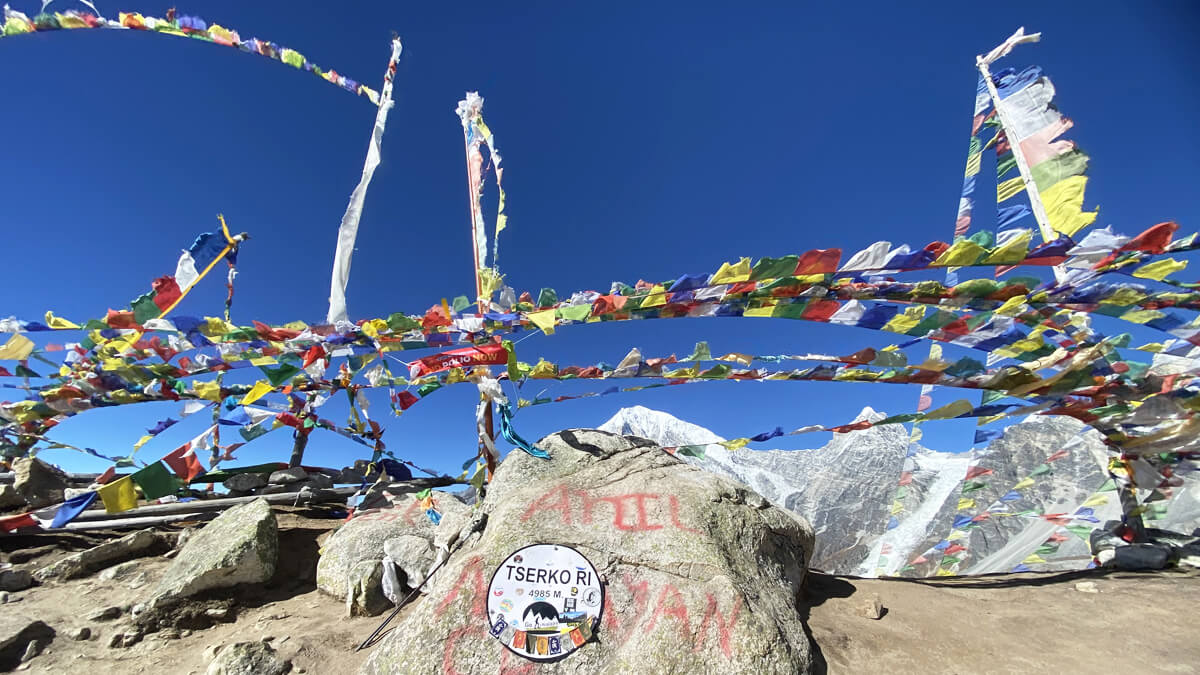
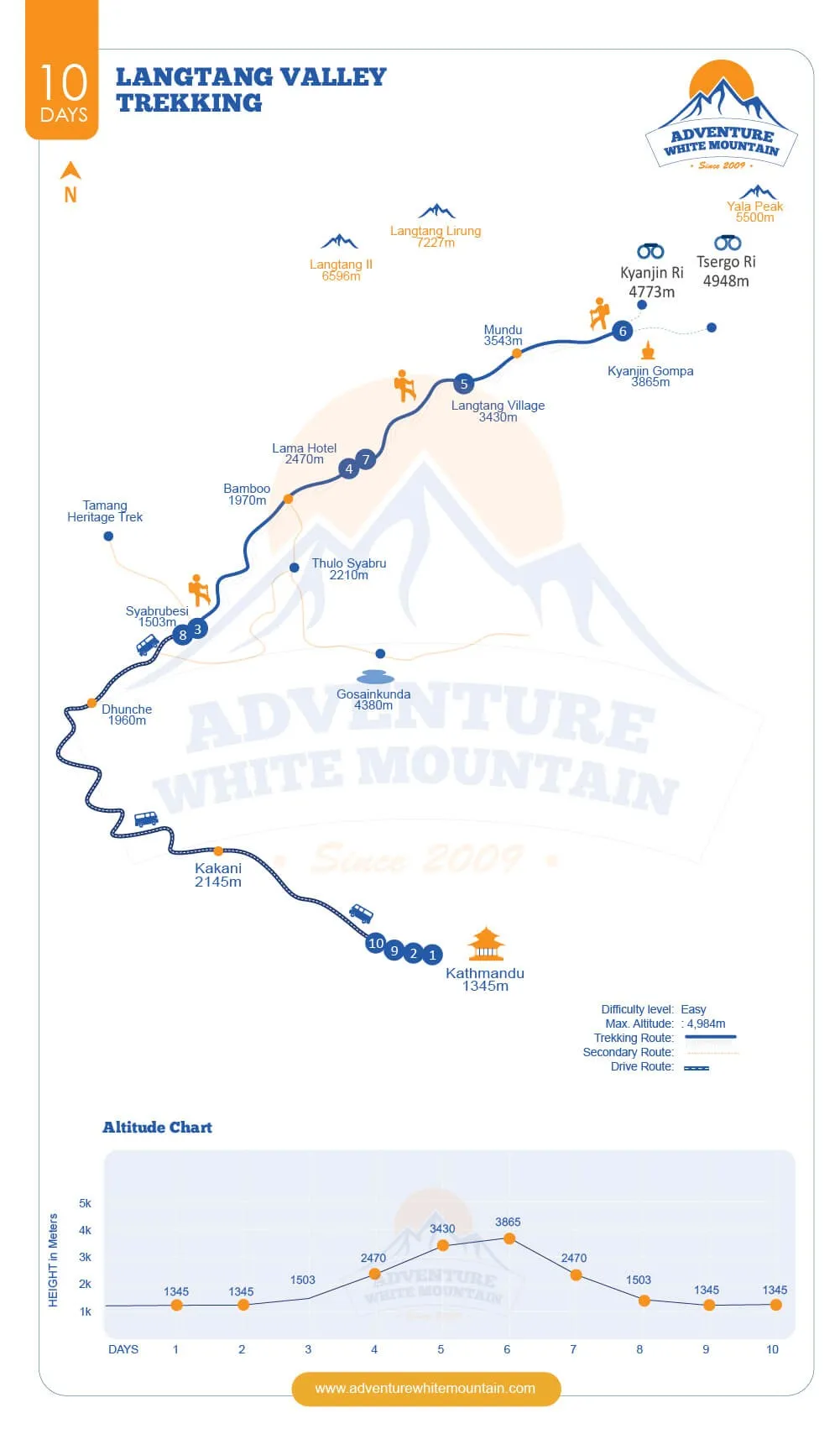
The Langtang Valley trek difficulty is moderate. It is best for both beginner and experienced trekkers. You walk 5 to 6 hours daily and gradually ascend in elevation. The trail stays under 4,000 meters and only goes above 4,700 meters during a side hike to Kyanjin Ri or Tserko Ri.
There are a handful of steep ascents and descents along the way, but for most of the trail you will enjoy a well-paced hike. If you are in good health and can manage around 6 hours of walking each day, you are eligible for the Langtang Valley trek.
Below, we have talked in a little detail about the challenges of the Langtang Valley trek and ways to overcome them to give you a better idea:
- Terrain: The Langtang Valley trek is an uphill walk (most of the way) until you ascend to Kyanjin Gompa and Tserko Ri. The terrain is rugged and steep with narrow, rocky sections. You will walk through jagged hills, forests, and narrow hillsides. Improve your stamina before the trek starts to walk on rugged terrain and use trekking poles to maintain your balance.
- Daily long hours of walking: You will walk 5 to 6 hours a day on average during the Langtang Valley trek. It is by far the most challenging aspect of the Langtang Valley trek, and every trekker must be capable of it. Practice long walks with a 5 kg backpack before the trek begins.
- The varying environment: Another thing that trekkers usually find challenging on the Langtang Valley trek is the varying elevation. You can feel hot one second and cold the next. Mornings and evenings are cold throughout the year, and the higher you ascend, the colder and drier the climate gets. You have to wear clothes in layers and carry ample SPF and moisturizer.
- High altitude: The good thing is you will stay below 4,000 meters for more than 95% of the trek and only go above 4,700 meters during the side hike from Kyanjin Gompa. The higher you ascend, the thinner the air gets. It will become challenging to hike. Maintain your pace, take small breaks, and keep yourself hydrated. Carry electrolytes and protein bars for quick energy.
- Limited service: The Langtang Valley trek is one of Nepal's oldest treks, but it is not as commercial as the Everest and Annapurna regions. So, overall trekking infrastructure is still lacking, especially in terms of premium lodges and amenities. You have to adjust a lot on this trek.
Langtang Valley trek fitness and preparation
When preparing for the Langtang Valley trek, you should focus on improving your physical and mental condition. For that, you have to exercise, go on long walks, and learn about the trek as much as you can.
- Strength training: Great for building your core, leg, and back muscles. You have to be strong enough to carry your 5 kg daypack and push yourself on uphill trails.
- Cardio: Cardio exercises will improve your stamina and endurance. It is a must for the trek. You can go swimming, cycling, running, etc.
- Regular walks: You cannot go from walking less than an hour a day to walking 5+ hours a day on mountainous terrain. It will be too much for your brain and body. So, make a habit of long walks. Ideally, walk while wearing a 5 kg daypack.
- Pack the right gear: Trekking with the right gear ensures your comfort and safety. If you are unsure about what to buy, wait till you arrive in Kathmandu. There are stores in Kathmandu that sell all sorts of trekking clothes and gear at a very reasonable price. Renting is also available for some gear.
- Book your trek early: Booking your trek early allows you to seriously prepare for the journey, and it also allows you to reserve the best rooms in the mountains.
How to handle altitude sickness on the Langtang Valley trek?
Although you will not ascend above 5,000 meters (apart from the Tserko Ri hike), the trail still stays three days above 2,500 meters. So, there is a risk of altitude sickness.
Altitude sickness is a common condition trekkers face because they are not used to high elevation (above 2,500 meters). Acclimatization is a crucial aspect of the trek.
To avoid altitude sickness, you have to adjust to high altitude, which means acclimatization. The Langtang Valley trek has a slow pace and controlled gain in elevation.
So, if you follow our itinerary and advice, you can complete the trek without any issues. The symptoms of altitude sickness are headache, loss of appetite, nausea, dizziness, vomiting, breathlessness, etc.
Altitude sickness preventive measures:
- Your body adjusts to high altitude better if you keep yourself hydrated. So, drink lots of water, soups, and ginger-honey tea daily.
- Avoid alcohol and smoking as they can severely dehydrate your body.
- Ascend slowly and maintain a steady pace.
- Listen to your body and inform your guide if you feel sick.
- Have carbohydrate-rich meals and get ample sleep.
Langtang Valley trek accommodation
On the Langtang Valley trek, you will stay at simple teahouses or homestays. These are standard basic accommodations for trekkers. The room costs between USD 5 and USD 15.
- Rooms: Twin-shared rooms with simple wooden beds, foam mattresses, pillows, and blankets are available for trekkers. Single rooms might be available in Syabrubesi and Lama Hotel.
- Bathrooms: Bathrooms are shared among trekkers. Be ready to use both squat and western-style toilets. Private bathrooms may be available in some teahouses.
- Heating: Rooms are not heated or even insulated. Trekkers can carry a sleeping bag for extra warmth and comfort.
Services and their charges in teahouses:
- WiFi: WiFi can cost USD 2 to USD 3. However, the network is not stable all the time.
- Charging: Expect to pay USD 1 to USD 2 per hour or device. Most teahouses depend on solar power for electricity, and it has cost them a lot to install. So, they charge a small fee to trekkers.
- Hot showers: Available in many teahouses, but we do not recommend taking a shower daily as it can increase the risk of altitude sickness. A hot shower is also a paid service in teahouses. It can cost USD 1.5 to USD 3 per shower.
Tips:
-
Cold weather makes sleeping troublesome. So, a high-quality sleeping bag is not optional but a necessity.
- The walls are not that thick. During peak seasons, the teahouse can get quite noisy. So, carry earplugs to sleep well.
- If you have a headache, sleep slightly elevated. You can put a folded jacket under the pillow.
- Separate your hiking and sleeping socks, beanies, gloves, and base clothes. You will feel fresh and light. It will help you fall asleep easily.
- A hot water bottle will provide you with extra warmth. Hug it while sleeping.
Hygiene during the Langtang Valley trek:
- Use hand sanitizers before every meal and after using the washrooms.
- Change your base layer regularly. Pack extra pairs of undies, t-shirts, pants, and socks.
- Use baby wipes or wet tissues to wipe your body on days you cannot take a shower and before bed. It will genuinely refresh you.
- Dry shampoo will be quite handy. You can also oil your hair.
- Pack a teahouse slipper. It will give you a break from the trekking boots.
- Pack a small microfiber towel. You will not get towels in lodges.
Food and drinking water during the Langtang Valley trek
We provide three meals a day during the Langtang Valley trek. You will have hearty Nepali meals such as thukpa (noodle soup), dal bhat, fried rice, momo, porridge, Tibetan bread, paratha, etc. Pasta, soups, pancakes, eggs, bread, oats, and muesli are also available.
Likewise, drink options include black tea, milk tea, ginger-honey lemon tea, Tibetan butter tea, sea buckthorn juice, sodas, and packaged juices. Boiled water is available at a very low cost in all teahouses. Some even give it for free.
Food tips:
- If you have any food allergy, inform us and your guide beforehand. Likewise, be attentive to what you eat during the trek.
- You may not feel hungry. It is common at high altitude. Still, you have to eat.
- Have a carbohydrate-rich meal like dal bhat or fried rice for lunch. It provides enough energy for long walks.
- Have an early dinner to help slow digestion at high altitude.
- Your sleep cycle may get disturbed. So, have a routine and go to bed on time. In peak trekking seasons, the teahouse can be noisy. We highly recommend noise-cancelling earbuds.
- Have garlic soup every evening and ginger-honey tea every morning. Both these drinks will help you acclimate and keep your immunity strong.
- Carry snacks to munch on while hiking. You can pack energy bars, nuts, dark chocolate, instant noodles, electrolytes, crackers, dried fruits, mints, hard candies, etc.
Do not drink alcohol while ascending to Kyanjin Gompa. Alcohol dehydrates, suppresses breathing, disrupts sleep quality, and leads to altitude sickness symptoms. And walking with a hangover is not safe.
Transportation between Kathmandu and Syabrubesi
We use a local bus or a shared jeep to drive from Kathmandu to Syabrubesi. If you have a budget, you can upgrade to a private jeep, which will be much more comfortable and flexible.
Communication on the Langtang Valley trek route
Mobile network coverage is available on the Langtang Valley trek route, but it is limited and unreliable. Likewise, WiFi is also available in most teahouses, but the network remains unreliable.
NTC and Ncell are two major mobile network providers in the Langtang Valley. NTC has better coverage in this region. Ncell network drops once you ascend above Syabrubesi.
Teahouses can charge NPR 200 to NPR 500 for WiFi. Connection remains slow and prone to dropping if the weather is disturbed.
Travel insurance for the Langtang Valley trek
For the Langtang Valley trek, you have to buy travel insurance that covers emergency helicopter evacuation up to 5,000 meters along with medical bills. Further, you can cover trip cancellation, personal liabilities, and loss/theft of personal belongings in your travel insurance.
Well-covered travel insurance is a mandatory requirement for the Langtang Valley trek. There are no good insurance providers for tourists in Nepal, so buy it online in your country and bring documents with you.
Luggage weight limit
During the Langtang Valley trek, every trekker has a 9 kg duffel bag weight limit and a 5 kg daypack weight limit. You can store any of your extra suitcases in our office or at your hotel's locker room for the trek duration. It is a complimentary service.
Tips for the guide and porter
The expected tip for the Langtang Valley trek is USD 20 to USD 25 for the guide and USD 12 to USD 15 for the porter. However, it is not a fixed amount. You can tip more or less as per your trek satisfaction level.
Tipping the guide and porter is a well-practiced culture in Nepal. Our packages do not include tips for them. So, we request our guests to prepare a good tip for your hard-working mountain guide and porter.
Nepal travel visa
You have to obtain a Nepal travel visa to enter the country for the Langtang Valley trek. All foreigners, except Indians, need a Nepal travel visa.
You can obtain the visa either from the Nepalese Embassy/Consulate Office in your country or upon arriving at Kathmandu Airport (on-arrival travel visa).
Note that the on-arrival travel visa is not available for travelers from some countries. So, kindly check the official site of the Nepal government for up-to-date information.
On-arrival travel visa:
You can get the on-arrival Nepal tourist visa at all international airports and border entry points. For a quick process, apply for the on-arrival visa at least 15 days before your arrival day in Kathmandu. Or, you can complete the visa form and pay the fee upon arriving at the airport.
Nepal tourist visa fees
- 15 days: USD 30
- 30 days: USD 50
- 90 days: USD 25
Our Langtang Valley trek package does not cover travel visa fees.
Documents required for a tourist visa:
- Valid passport (minimum 6 months' validity)
- Completed visa form
- Visa fee (cash/card)
- Passport-size photo (rarely required now—often taken digitally)
Safety tips for the Langtang Valley trek
The Langtang Valley trek is a remote adventure at high altitude in Nepal. The trail goes through isolated forests and hills. You will navigate steep ascents and descents, altitude sickness risks, varying weather patterns, and landslide-prone areas.
Similarly, mobile networks are also not available throughout the way. In terms of medical facilities, there are not many options either. If any unforeseen circumstance arises, we have to immediately evacuate you to Kathmandu.
So, you have to be very careful while trekking and trek with a trusted, expert local travel partner. We have shared some helpful tips for the Langtang Valley trek below:
- Buy well-covered travel insurance (must include helicopter evacuation) and carry a personal first-aid kit.
- We highly recommend trekking with a porter. He will carry your duffel bag during the trek. It allows you to hike safely and enjoy the trek freely. Our Langtang Valley trek package is inclusive of a strong porter.
- At high altitude, we recommend asking about the freshness before having it. As the refrigeration system is still not great in all teahouses, you have to be careful.
- You may come across yaks or mules during trekking. While sharing trails with them, wait on the cliffside and let them pass first. Do not pet them or disturb them.
- Do not drink water directly from the tap or stream. You may not be able to digest it. Treat it with a water purification tablet before drinking.
- Download an offline map, pack extra batteries and snacks, and keep a whistle in your daypack.
ATM and money exchange
The Langtang Valley trek route does not have ATMs. So withdraw money to use during the trek and for tips for your guide and porter in Kathmandu.
For personal expenses, you can carry USD 100 to USD 150. If you are interested in yak cheese or local souvenirs, definitely have USD 50 to USD 100 more.
There are many money exchange centers and banks in Thamel where you can easily exchange your money. Your hotel may also help you exchange money.
You can withdraw money easily via an ATM using your international payment cards. There can be a small international transaction fee, so consult your bank before flying to Nepal.